A colleague once told me that every written research proposal is also a potential publication. By which he meant: try to maximize the impact of the work that you undertake. When I decided to learn the Swift programming language in 2022, I also determined to use that effort to help others with a Pascal background navigate the same path.
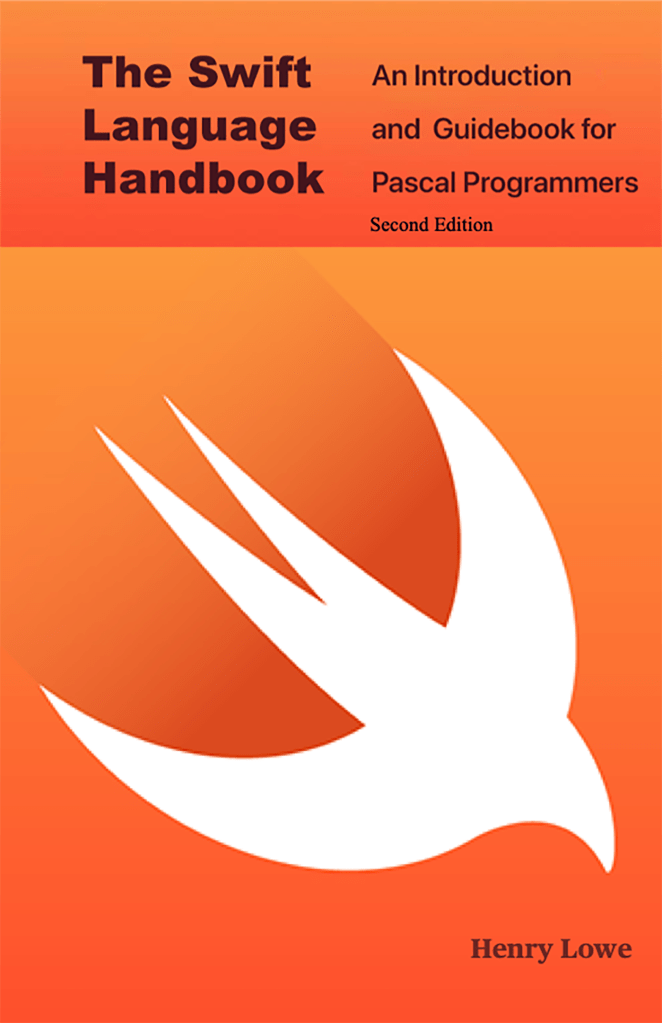
The result is a book: The Swift Language Handbook – An Introduction and Guidebook for Pascal Programmers that is now available on the Apple Books Store and the Amazon Kindle Store. In April, 2026 I published the Second Edition of this book which corrects typographical errors in the first edition, updates many topics to reflect the evolution of the Swift language and adds a new chapter on Swift Closures.

The book links the core concepts of Pascal to the equivalent concepts in Swift to facilitate that “Aha!” moment when one gets a firm conceptual foothold on a new programming language. The goal is to create a conceptual bridge between these two elegant programming languages and to demonstrate their shared heritage.
I have programmed in many languages over the years: BASIC, 6502 Assembly, Pascal, Object Pascal, MUMPS, C, C++, Java, HyperTalk, AppleScript, LiveCode and now Swift. In each case comprehending the core language concepts and then expanding one’s knowledge progressively by actually coding with the language has always worked for me. The first programming language is always the hardest to learn because one has to understand the core concepts of programming in addition to nuances of the language.
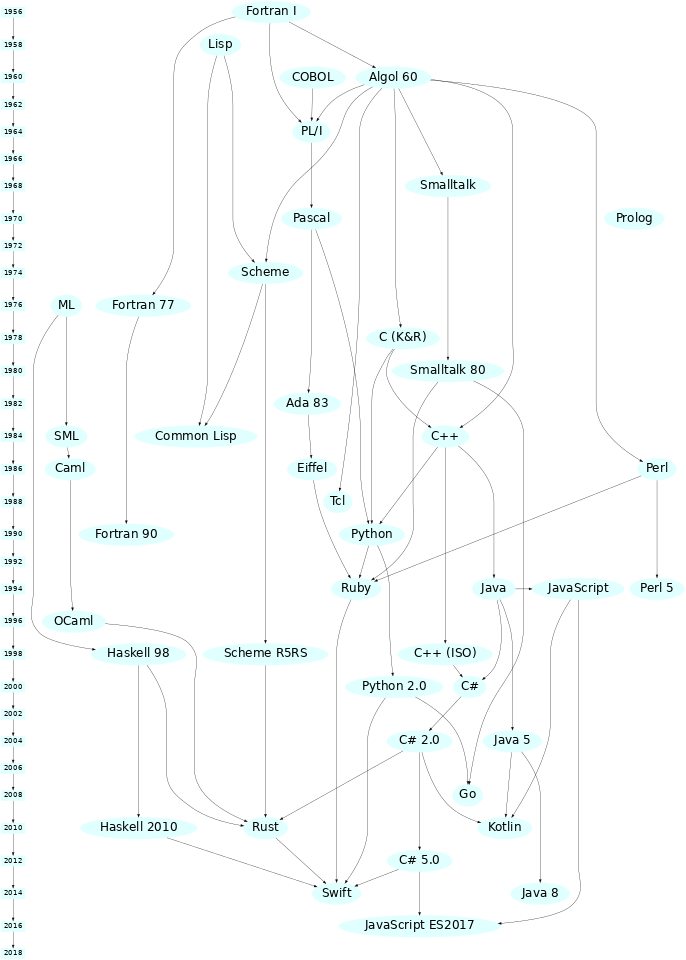
However, subsequent languages are often easier to learn if they are related to a language one has already learned. This is, in part, because programming languages have evolved in an evolutionary fashion. Fortran (1957) begat Algol (1958), which begat Algol 60 (1960), which begat Pascal (1970) and C (1972 – via BCPL). Swift is a descendent of C, via C++ and Objective C (which was also influenced by SmallTalk).
Swift is a compiled open-source procedural programming language developed by Apple and the open-source community. Work on Swift began at Apple in 2010. Swift was designed to replace Apple’s earlier default programming language Objective-C, which lacked many modern language features. Swift was first released in 2014 and is currently at version 6.3 (March 2026), supporting all Apple platforms,Windows and Linux.
The book is not intended to be a comprehensive reference guide to Swift. Nor does it cover using the language with Apple’s Xcode development environment . Instead, if you have a working knowledge of Pascal, the book links the core concepts of Pascal to the equivalent language concepts in Swift, to facilitate that “Aha!” moment when one gets a firm conceptual foothold on a new programming paradigm.
Download a free PDF preview of the book that includes the table of contents, the first two chapters (Introduction and Operators) and a comprehensive index.